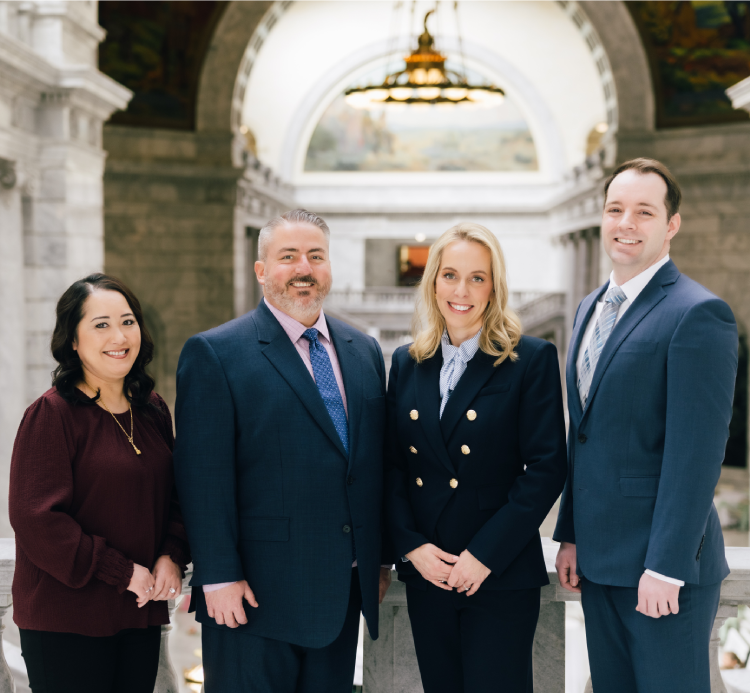
Top Criminal Defense Attorneys in Salt Lake City, UT
Our team of experienced trial attorneys can carefully look at every detail of your case. We fight for the optimal outcome, from dismissing your case to reducing your charges to going to trial; we help you understand all of your legal options. No matter why you need a Salt Lake City criminal defense lawyer, you can turn to us for help.
We’re here to stand by you every step of the way. From your first call to the courtroom, you’ll get clear answers, honest support, and powerful legal defense.
Need Help Now? Contact Us for a Consultation
We don’t just defend cases — we defend people. With care and experience, we’ll guide you through your criminal trial and give you the support you need. Let us help you move forward.
Don't Wait. Call Us Today.
Why Hire Blackley & Wingad as Your Criminal Defense Lawyer
The Salt Lake City Police Department made 12,427 arrests in 2025. Of those, 1,667 were violent offenses and 10,760 were crimes against property. The most prevalent category was larceny or theft, with 5,906 arrests that year.
If you are facing criminal charges of any kind, the attorney you choose matters more than most people realize. Not every criminal defense lawyer in Salt Lake City has stood inside a courtroom on the day a verdict is read. Beau Blackley and Jennie Wingad have done it more than 100 times.
Former Public Defenders Who Know Both Sides
Before founding Blackley & Wingad, both attorneys served as public defenders in Miami, Florida, one of the busiest and most demanding criminal court jurisdictions in the country. That experience is not something that can be replicated in a seminar or learned from a textbook. It means they have cross-examined detectives, argued Fourth Amendment motions before skeptical judges, and taken serious felony cases all the way through verdict. They know exactly how prosecutors build cases because they spent years working alongside them.
Trial Attorneys, Not Settlement Attorneys
Many criminal defense firms settle cases because going to trial is expensive, unpredictable, and time-consuming. At Blackley & Wingad, trial is not a last resort — it is a core part of their identity. Prosecutors in Salt Lake City know which defense attorneys are genuinely prepared to try a case and which ones are not. That reputation affects every negotiation. When the other side knows your attorney will go to trial, the dynamics of every conversation change.
Deep Knowledge of Salt Lake City Courts
Blackley & Wingad actively practice in Third District Court in Salt Lake City, the court that handles the most serious criminal cases in the county, including all felonies and Class A misdemeanors. They know the judges, the prosecutors, and the tendencies of each courtroom. Local knowledge of this kind is not something an out-of-town attorney can replicate.
Available When It Matters Most
Arrests happen at night, on weekends, and on holidays. Bad news does not wait for business hours. Blackley & Wingad are available 24 hours a day, seven days a week for clients who need immediate guidance after an arrest. Getting a lawyer involved in the first hours after an arrest can make a meaningful difference in how the case unfolds.
What We Can Do for You
From the moment you call, we get to work. We file paperwork and keep track of all court dates, file pre-trial motions, evaluate the prosecution’s case against you, build an effective defense strategy, gather and analyze evidence, and challenge any unconstitutional police conduct. If your case goes to trial, we provide full courtroom representation from arraignment through verdict. You will not be handed off to a junior associate. Beau Blackley and Jennie Wingad handle their clients’ cases personally. every step of the way, from your initial arraignment through to the very end.
Criminal Law Defense in Salt Lake City Utah
Murder/homicide means unlawfully killing another person. These charges are very serious, and you need a strong legal defense right away.
This is when someone tries to kill another person but doesn’t succeed. Even if no one dies, it’s still a serious charge requiring an experienced legal team.
Assault occurs when someone causes injury to another person or causes concern about immediate bodily harm.
Identity fraud is knowingly or intentionally using or attempting to use the personal identifying information of another person with fraudulent intent. We are available to discuss the nuances of these charges with you.
This means keeping someone somewhere against their will. Even short detainment can lead to criminal charges.
Causing someone’s death by being reckless — not on purpose — is called manslaughter.
Driving carelessly or without thinking and causing someone’s death can lead to major legal consequences.
Aggravated robbery is robbery while using a dangerous weapon, causing serious bodily injury, or taking an operable vehicle.
Robbery is unlawfully and intentionally taking or attempting to take property of another by means of force or fear.
Failure to stop at the command of an officer occurs when someone fails to comply with a law enforcement officer’s verbal or visual command to stop for the purpose of avoiding arrest.
Possession of a dangerous weapon by a restricted person is the unlawful possession of any weapon or instrument that can be used to cause serious injury or death.
Aggravated assault involves any assault that results in serious bodily harm or the use of a deadly weapon. Assault occurs when someone causes injury to another person or apprehension of immediate bodily harm. We help navigate all the consequences associated with these accusations.
Assault against a peace officer is an assault or threat of violence against a peace officer acting within the scope of their authority.
Kidnapping is detaining or restraining an individual for any substantial period of time or detaining or restraining an individual in circumstances that create a risk of bodily injury.
Possession of a dangerous weapon by a restricted person is the unlawful possession of any weapon or instrument that can be used to cause serious injury or death.
Possession of a firearm by a restricted person is the illegal possession of any type of firearm.
Felony discharge of a firearm is when someone discharges a firearm with malicious intent or in the direction of another person.
Felony discharge of a firearm with injury or serious injury involves the intentional use of a weapon that results in serious physical injury.
Criminal mischief/destruction of property occurs when someone intentionally damages another person’s property without their consent.
Distribution of an intimate image occurs when someone knowingly or intentionally distributes an intimate image of an adult, without the person’s consent, knowing it would cause that person to suffer emotional distress or harm.
Stalking is the repeated harassment or threatening behavior directed at another person with the intent to cause fear or distress.
Penalties for Misdemeanor Versus Felony Charges
Utah classifies crimes into one of three categories: felonies, misdemeanors, and infractions. Infractions are the least serious type of charge. Misdemeanors come next, followed by felonies.
What to Do if You’ve Been Accused
If you’ve been accused of committing a crime, the steps you take in the first 24 hours following your arrest can dramatically impact your criminal defense case. No matter why you’ve been arrested, you should:
- Exercise your rights. You have the right to avoid incriminating yourself and the right to legal counsel. Don’t speak to the police until you have a lawyer, and don’t consent to searches.
- Preserve evidence. If you have any records of texts, calls, receipts, location data, or photos on your phone, don’t delete them. You should preserve evidence related to your case.
- Avoid discussing your case. Don’t discuss your case with anyone other than your lawyer, especially over recorded jail lines, on social media or with your family.
- Hire a lawyer immediately. You should consult a lawyer as quickly as possible after your arrest. Bring essential documents to your consultation, such as your citation, booking sheet, bail paperwork, and any information about prior cases.
- Don’t Google your questions. Save them for your lawyer who can provide reliable information!
If you have any questions about what to do or what not to do, you should direct them to your Salt Lake City criminal defense attorney.
Potential Legal Defenses Against Criminal Charges
The legal defense you use in your case will depend on what you’re being charged with and the specific circumstances surrounding your case. Your lawyer can help you come up with an effective defense strategy by evaluating the prosecution’s case and the available evidence. Common strategies include:
- Actual innocence. You can claim that you are innocent of committing the crime. Your attorney needs only to prove that there is a reasonable doubt of your guilt. The burden of proof is on the prosecution.
- Alibi. If you were somewhere else when the crime was committed, it will be difficult for the prosecution to claim that you were directly involved.
- Self-defense. If you’re being accused of committing a violent crime, a self-defense claim could be a valid way to fight the charges. To argue this claim, your attorney must show that you were afraid of imminent harm and used force appropriately against your potential assailant.
- Entrapment. When law enforcement convinces someone to commit a crime, that’s called entrapment. If you wouldn’t otherwise have committed the crime, it’s a valid legal defense.
- Rights violations. If the police violated your constitutional rights through an unlawful search and seizure or a failure to inform you of your rights following your arrest, any evidence obtained could be thrown out, leaving the prosecution without sufficient proof for their case.
- Insanity defense. The insanity defense is not as common as modern media might have you think. It is difficult to prove, and even if you successfully implement an insanity defense, you’ll likely still face incarceration in a hospital instead of jail.
- Lesser included charges. Sometimes, arguing for a lesser included offense is a good way to mitigate harm. For example, being convicted of theft is less serious than a burglary conviction.
Where Salt Lake City Cases Are Handled
Where your case will be handled depends on the nature of the charges you’re facing. Most Class B and C misdemeanors and infractions are tried in the Salt Lake City Justice Court, at 2001 State Street. Felonies and Class A misdemeanors, on the other hand, are filed in the Utah District Court, in West Jordan at 8080 Redwood Rd West Jordan, UT 84088.
The location of your trial tells you where you need to show up for court hearings. The procedures are slightly different based on your level of charges and which courthouse you attend. The primary differences between the justice court and district court include:
- Level of offense. The district court handles more serious crimes, while the justice court focuses on resolving less significant criminal justice issues.
- Hearing types. The trial process in the justice court usually starts with an arraignment, which you can waive if you have counsel, and moves directly to a pretrial conference before going to trial. In the district court, the process starts with an initial appearance that cannot be waived, and you must attend an additional preliminary hearing that’s not required at the justice court.
- Appeals. There is also a difference in how decisions are appealed. The justice court’s decisions can be appealed to the district court as de novo proceedings, meaning the entire process starts over from the beginning at a different court. In the district court, your appeal would go to the court of appeals, and the process would not be started over.
These differences mean your lawyer may need to employ slightly different strategies depending on which courthouse your case is heard in.
Salt Lake City's Choice for
Criminal Defense Lawyers
Utah Criminal Case Process
While the process is slightly different depending on whether you go to district court or justice court, there are more similarities than there are differences. Here’s what you can expect:
- Investigation and arrest. You will be investigated by law enforcement, leading to your arrest. At this point, you should obtain legal counsel.
- Initial appearance. For felonies and Class A misdemeanors, your next step will be your initial appearance. Bail will be set, and no-contact orders for witnesses will be issued.
- Waiver hearing. For Class A misdemeanors and felonies, your next step will be to attend a waiver hearing. This hearing allows you to waive your right to a preliminary hearing and schedule an arraignment instead if you so choose.
- Preliminary hearing. At the preliminary hearing, only applicable for Class A misdemeanors and felonies, the judge evaluates the evidence to decide if there is probable cause to continue to trial. Only the prosecutor is required to present a case during the preliminary hearing.
- Arraignment. The arraignment is the next step of the felony or Class A misdemeanor legal process or the first step of the Class B or C misdemeanor process. You enter a plea at arraignment, and if you plead not guilty, the court schedules dates for the next steps, including your trial.
- Pre-trial motions. Before the trial begins, your lawyer can introduce motions to dismiss, motions to prevent the admission of certain evidence, or motions to require disclosure of evidence. This pre-trial stage allows your lawyer and the prosecutor to bring up issues with each other and the Court to answer questions before executing the trial.
- Pre-trial conference. There may also be a pre-trial conference. During this hearing, your lawyer and the prosecutor may attempt to negotiate an agreement to settle the case.
- Plea bargaining. During this stage, your lawyer can negotiate with the prosecutor to try to come up with a plea bargain to satisfy both sides. The judge must approve any agreement. If you go this route, you’ll plead guilty or no contest and move to sentencing, if applicable. Otherwise, your case will go to trial.
- Trial. At your trial, the prosecutor will present their case. Whether your lawyer presents a case is a detailed strategy decision that is not always employed in a criminal case given that the burden of proving the case rests entirely with the prosecutor. At trial, you may have a jury, or your case may be decided by a judge alone. The trial process involves opening statements followed by the presentation of evidence and witnesses. After the closing arguments, the judge issues jury instructions, and the jury decides whether to issue a guilty or not guilty verdict.
- Sentencing. If you’re found guilty or accept a plea bargain, you’ll be sentenced anywhere from two to 45 days after your conviction. You can opt for earlier sentencing, choosing to be sentenced the same day you are convicted, or you can push the sentencing date out if you want more time to prepare.
- Appeal. In Utah, you have the right to appeal a final judgment to a higher court to review for legal errors. An appeal must be filed within strict deadlines and requires filing a Notice of Appeal. Discuss your specific appellate rights with your lawyer.
Your Salt Lake City Criminal Defense Lawyer
Whether you’re facing Class C misdemeanor or felony charges, you can benefit from working with a Salt Lake City criminal defense lawyer like those at Blackley & Wingad. Our team has been practicing criminal defense law for decades. In that time, we’ve defended clients facing everything from simple misdemeanor charges to incredibly complex felony cases. We can help you, too. Contact us to schedule an initial consultation today.
Salt Lake City, UT Criminal Defense Resources:
How a Criminal Conviction Can Affect Your Professional License in Utah